This blog has slowly transformed into a place where I just publish annual year in review posts. I may still consider other types of posts in the future, but for the time being, I will be sure to at the very least maintain this annual tradition.
This is the 13th one of these year end reflective posts. If you are curious, you can see my reflections at the end of 2024, 2023, 2022, 2021, 2020, 2019, 2018, 2017, 2015, 2014, 2013, and 2012.
I’m a big fan of the value of self reflection, so I get a lot out of taking time to round up, and try and synthesize things at least once a year. If you are curious about what I’ve been reading about, you can check out the 50 some I read this year in order on Goodreads.

Rounding Out Year Two at AIP
I started as AIP’s first Chief Research Officer in February of 2024. So, 2025 was my first full year in this role. I feel like I hit my stride this year. Back in January we put out AIP’s first annual research agenda. Over the course of the year, the fantastic team of social scientists, historians, archivists and librarians that I support delivered a lot of great results aligned to that agenda.
At the start of the year we launched an interactive with info on physical scientists and engineers employed by the U.S. federal government. In April, we put out a report on the Impacts of Restrictions on Federal Grant Funding in Physics and Astronomy Graduate Programs. In the fall we published a short report that provides data on International Students in U.S. Physics and Astronomy Graduate Programs and some of the first national data so far to document a decline in STEM graduate student enrollments. That is just a sampling of some of the 17 reports that our social science team put out this year.

While I am proud to have supported all of that work, I should note that I am particularly proud of this report that we came out with in this month that focuses on the stories of 22 different early career volunteer leaders in science and engineering societies in AIP’s federation. Along with that report, we were able to put out this article earlier in the fall in Physics Today that focuses in on four of the early career leaders stories and offers practical and clear advice for early career professionals and their mentors.
In support of that research agenda, we were able to kick off some great digital collecting initiatives through AIP’s Niels Bohr Library and Archives. We launched a new tool to receive photo submissions from physical scientists and kicked off a new initiative founded by the Henry Luce Foundation focused on documenting and celebrating women’s contributions to the physical sciences. In September we kicked off a project to collect stories from physical scientists whose career journeys have been impacted by funding cuts. Following along with our focus on collecting photos this year, I also wrote a piece for Radiations Magazine about my experience encountering the NIST-4 Kibble Balance.
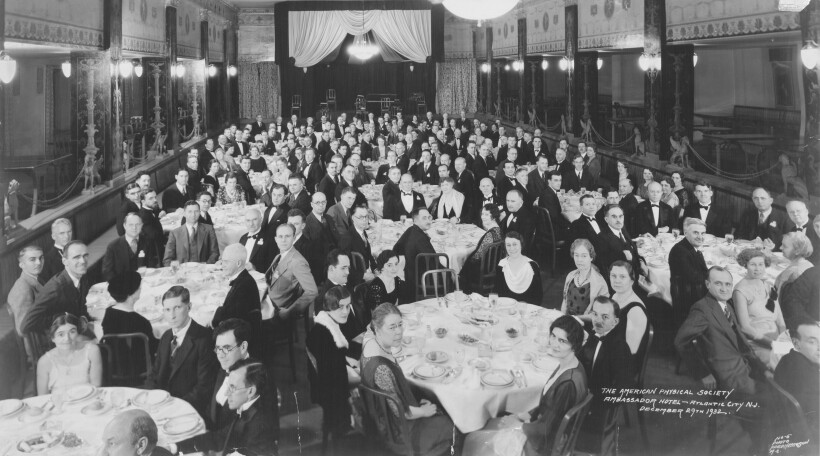
Dinner of the American Physical Society (APS) at the Ambassador Hotel . Fred Hess & Son, courtesy AIP Emilio Segrè Visual Archives, gift of Mark Zemansky.
Along with those activities that help to advance that overall research agenda, I was able to make some time to explore and share out some small stories highlighting some of the unique historical materials of the Niels Bohr Library and Archives. I wrote about a fun story that Physics Today ran in 1969 to identify everyone in a photo from a banquet at an American Physical Society conference from 1932. I also wrote a short piece exploring some telegrams and photos in our collections from the J.H. Van Vleck papers. I wrote about Jack Oliver’s fascinating memoir, Shakespeare Got It Wrong, and used that as a prompt to invite more physical scientists to document their lives in memoir for us to preserve and provide access to. I was then excited to share out about some of the new memoirs from scientists that we received for the Sigma Pi Sigma newsletter.
I also interviewed a number of researchers and memory workers about their work. I interviewed author Olivia Campbell about her book Sisters in Science: How Four Women Physicists Escaped Nazi Germany and Made Scientific History. I interviewed the sociologist of science Janet Vertasi about her ethnographic research on robotic space missions. I interviewed historian of science Joe Martin about his research on the history of the development of solid state physics. Lastly, I interviewed Leontien Talboom about her work at Cambridge University Libraries with Stephen Hawking’s floppy disks.
Web Archives & Digital Preservation
I’ve been channeling most of my research and writing energy directly into my work at AIP. With that said, I did also make some progress on a few other side projects related to web archiving and digital preservation that I had been working on for a while. Ben Lee, Jonah Estess and I had a piece on digital traces and records of Colin Powell’s Case for War in Iraq PowerPoint on the web come out in the journal Internet Histories.

I was also able to get the full manuscript Digital Preservation: A Critical Vocabulary, the edited volume that Rebecca Frank and I have been working to support, up online and submitted. I anticipate that we will likely be able to get the final version of the book worked through the process to be published next year.
Bridging the Last Book and Work at AIP
In the spring, I was invited to give a talk on campus at the University of Michigan as part of their Data, Archives and Information in Society Seminar program. It was great to get the chance to talk a bit with students and faculty and further develop the through-line between my last book, After Disruption: A Future for Cultural Memory which came out last year and the work that I’m supporting around collective memory in my role at AIP.

Along with that, I was thrilled to have the chance to have a conversation with Shannon Mattern about the book and in the context of all the disruptive change that has been happening to the culture memory community as part of the Internet Archive’s Future Knowledge Series.
Last but not least in this run of interviews, I very much appreciated the chance to participate in a two part interview post, Science As Story, Memory as Infrastructure (part two) for the Society for Scholarly Publishing’s Scholarly Kitchen blog with Wendy Queen. That presented a nice opportunity to discuss how the work I am trying to support these days is focused on demonstrating ways that social science and humanities work and research can, and should, support empowering positive change in the physical sciences.

Along with all that work and interaction, I was honored to be invited back to Madison Wisconsin this fall to be recognized as a luminary of alum of the institution. While I was back in Madison, I also had a conversation with some of the current students in the Integrated Liberal Studies program about careers and the role of study of the humanities. There is a nice piece about that event in the fall newsletter from the Integrated Liberal Studies Program. I was also honored to be inducted into Sigma Pi Sigma, the physics and astronomy honor’s society this fall.
Travel and Exploration
There was a good bit of travel and exploring this year too. We rang in the new year at a cabin out in the woods in West Virginia. We had an amazing trip to Japan at the start of the year. We had a few trips back to Chicago for family events. I ended up getting the chance to go to Alaska for a quick trip for work. I got to Santa Fe and Denver for meetings. I tagged along with Marjee for a conference she was going to in San Fransisco. We went for a getaway out to the beach in Delaware and we went up to Woodstock NY for a bit to see the leaves change.


 Trevor Owens