One more round of site theme ideas. I think I might really like this round. Do folks like these more or less then the last batch? I did not fill in all the content for these, just a few boxes and headings to give a sense of the concept. Each of them would take a bit more work. These are generated out of cut up shots from mega man, so I would be mushing and chewing on those original images a bit, but I thought I would share these.
Two weeks ago our Creating History in New Media class had a great chance to chat with historian David Staley about his book Computers Visualization and Historyand Scott McCloud‘s book Understanding Comics. New media provides some exciting places to take conversations about visualizations in history, but one of my other take-a-ways from the conversation was that there are a lot of places to talk about historical visualizations in old media.
I know that I said it’s not about pictures, but for those of you interested in pictures there are some neat projects that you can look to. To (quite literally) illustrate the point, here are a few examples of some of some dead tree picture based visualizations.
Children’s Picture Books
Below is a shot from Peter Sis’ The Tree of Life: Charles Darwin. Each page of the book places the primary content of the story in the center circle and frames. The picture below isn’t the best example but it does a good job demonstrating the way the side stories leaf into the center image to express different parts of a related story. Over the last thirty years or so critics and artists have developed several different works that explore how picture books work. Folks interested visually communicating history might do well to borrow from their work.
As I mentioned, alongside Computers Visualization and History our class also read Understanding Comics. It is worth mentioning that comics themselves are becoming a compelling medium for visually communicating history. In my own area of interest, the History of Science, Jim Ottaviani and Jay Hosler have developed some fantastic examples of what you can do with comics. Below is a page from a great book about Darwin’s ear ticks by Hosler.
Photos of Legos With Currency
Ok it doesn’t really fit, but it’s awesome-ness outweighed its misfit-ness, so here it is.
So, why have I pulled together these images? To demonstrate that there are already communities of comic and picture book artists interested in presenting historical information to young and old alike, many of who are doing a bang up job. There is enough material out there to just focus in on a single figure like darwin and see different examples from these fields. If historians want to think more about developing picture based visualizations they would do well to try folding in insights form these different communities.
This is a quick smattering from the hundreds of different free online history games and interactives I have come across. This slice of the history games web underscores a few key points behind building the Playing History collaborative directory.
First, the list gives a quick sense of the different diversity of groups making history games. Each of these places have their own silos of content, making it nearly impossible for teachers to get a quick sense of what sorts of games are out there on a given topic.
If you get a chance to click through some of the links you will get a clear sense of the other need Playing History can address. The quality of these games and interactives varies widely. By allowing educators to rate and review these games in one central location Playing History can ensure educators can find both topical an high quality games.
If you get a chance to take a look at some of these post your reactions and thoughts about them in the comments.
From NOVA via WGBH Boston
Escape from Antarctica– Students relive Ernest Shackleton’s voyage from Antarctica’a Elephant Island to South Georgia island using a sextant and a chart. Galileo’s Experiments– Students conduct virtual versions of Galileo’s thought experiments, including those using an inclined plane and a pendulum. Map of the Maya World– Students explore 15 Mayan cities in an interactive map.
From the National Museum of American History
You Be the Historian– Students examine objects left behind by the Springer family, who lived in Delaware more than 200 years ago.
From Colonial Williamsburg
Williamsburg Coins: Students examine the diverse types of money jingling in the pockets and purses of colonial ancestors.
Attack on Pearl Harbor– Students explore the virtual battleground through an interactive map The Emperor’s Tomb– Students enter the mysterious tomb of the first emperor of China.
I am excited to taking Jeremy Boggs course “Creating History In New Media” to round out my MA in American History. The syllabus is pretty exciting, if a bit overwhelming, mix of tech skills (HTML, CSS and using WordPress and Omeka) with readings in project management and process for web design. If your into this sort of thing take a look at his syllabus.
Over the course of the semester each class member, ideally working in groups, will work a digital history site from bar napkin sketch to launch. I am lucky to have teamed up with Jim Safley, CHNM’s Web Programmer and Digital Archivist, to work on putting together a smaller scope version of the Playing History project. (If you don’t feel like clicking the link Playing History will be a collaborative directory for educators to find, review, and post lesson plans relating to freely available history games they can use in their classrooms.) Jim and I will be using Omeka as our CMS.
Blogging is a big part of this course. Most of my classmates will be putting together class specific blogs that assume a considerable amount of shared classroom experience. That’s great. I plan to take a slightly different tack.
While I will be participating in that community, I also want this blog to continue to serve a more general audience of folks interested in my particular take on digital history/humanities stuff. I have two primary reasons for doing this, the first of which is altruistic, and the second of which is a bit more self serving.
(1) I don’t think many history programs offer this kind of course. So if anyone wants to virtually audit it: grab a copy of the syllabus, and subscribe my RSS feed to follow along as we work through it together. I intend to post general class reactions to projects and readings alongside my own reactions, as well as, general information about how our class sessions worked. I think this, in conjunction with the course site, should also provide fruitful food for thought for educators interested in developing similar kinds of courses.
(2) I really think the Playing History project Jim and I are working on is a valuable endeavor and the more folks we can get to react to our planing documents (sitemaps, wireframes, photoshop mockups, HTML mockups, and final product) the more likely we will be able to launch a compelling first iteration of the Playing History idea.
For all the talk of read/write culture and how digital media has blurred the lines between producer and consumer, (or even prosumer if you like making up words) there is much less conversation about learning to write code. In my experience these conversations happen, almost exclusively, about tools that use graphical interfaces and wysiwyg editors for content creation. I think Marc Prensky is right in suggesting that programing itself is a new literacy, or even better yet I would suggest it’s really a deeper conception of digital literacy. In calling something a literacy were making it a fundamental, and I think the database driven programmatic nature of new media requires that folks start to take a proactive approach to making programing a part of our general education approach.
Before we can even really talk about that goal however there is something I think we need to figure out first. Many people don’t think they have it in them to work with code. I have seen people who are masters at manipulating things in complicated programs with graphical interfaces. Folks that can do amazing things in Final Cut, people who have no trouble troubleshooting issues that arise with their operating systems, but who power down when anything from HTML to C++ is mentioned. I frequently hear, “I can’t do that”, “I’m not a coder” or similar statements rooted in idenity, afinity and self-efficacy.
It is important to note that I say this, not as a confident coder but as someone who has gotten over his own fears about working through hunks of code. The things I have done, editing and tweaking Omeka and WordPress themes, hacking CSL‘s to get customized export from Zotero making a minor fix to one of Zotero’s translators, all required no training in JavaScript, or XML. Once I was comfortable with skipping chunks of stuff I did not understand I was generally able to get these things to do what I wanted to do. In these cases at least, the biggest barrier was my own lack of self efficacy with the idea of doing things with code.
There are a lot of great ways learn to code. (For a good list check out Karin Dalziel’s post, its directed at librarians but there are some great resources there.) However, I have not seen much work focusing on how we can get people over the paralysis that comes from the belief that it writing code is outside their grasp. To really break down these barriers, and get more folks to a deeper level of digital literacy, I think we need to know more about where that fear comes from and start developing stratigies for overcomming it.
Last Friday I was excited to rediscover RPG Maker, a windows only, no-programing skills necessary, platform for building role playing games. The tool allows you to create games with the look and feel of mid-nineties Super Nintendo Games like Final Fantasy VI, Breath of Fire, or EarthBound. As an avid gamer and proto-historian I was excited to see if RPG Maker could be used to build historical RPGs, or, if not that, at least playable proofs of concept. After a few hours of fun with the program I am happy to report that I think it can serve both these purposes.
Through the tools relatively simple interface you can very quickly create maps, characters and edit all the other RPG staples like character classes, skills, and items. I have always thought Darwin’s voyage to the Galapagos would make a neat RPG so I thought I would start by playing around with that. Below are some screenshots from my 2 hrs of work.
Darwin Quest Title ScreenCharles is apparently a level one naturalist
RPG maker comes pre-loaded with generic map tiles and each tile already comes with standard properties. For example you can’t walk on water tiles but your ship can sail on them. So with a few minutes of playing around with the tiles and a map of the Galapagos I had a functional recreation of the islands for my game. I also used a visual basic sprite generator one of the members of the RPG Maker community built to make a little Darwin character for the main map. You can see him, the map, and the HMS Beagle in the image below.
Darwin on the Map
Here is where the interesting stuff starts. RPG Maker allows you to create events triggered through simple interaction, and then use those events flip global switches that can then impact any number of other interactions. So, in a simple example, a designer could require the player to observe 10 finches on the island to trigger a switch which would give the player an item called “Finch Observations”. Now, the player can use that item to say win an argument, or form a theory. What is exciting here is not my example, which is actually pretty weak, but the fact that this platform allows folks interested in these types of games to jump into development, with basically nothing more than the investment of their time, and get right to the heart of interesting game design questions. You can skip all the programing and start making a game today.
Darwin finds a finch (Ok, I know it looks like a chicken)
Now, the fact that RPG Maker requires basically no programing experience does mean that it imposes some strong limitations on the kinds of games and the kinds of game play you can develop. After a bit of head scratching I think I am getting close to some ideas for how to use the mechanics behind the RPG standard “kill some monsters-to get experience points-to level up-to kill some tougher monsters-repeat” model to build some very different kinds of player experiences.
I should mention that a lisence for RPG Maker costs 60 bucks, you can try the 30 day trial for free though. Beyond just using the platform, it looks like that fee allows you to make and distribute any game you develop in any way you chose.
In 1956 Disney published Our Friend the Atom as a compliment to a film and exhibition by the same name. The book uses a fable of a fishermen and a genie to explain the relation between people and atomic science, and the book strangely simultaneously offers much scarier visuals of the destructive power of atomic science than one would expect children of the fifties would have been exposed to but still manages to present a Utopian view of the future potential of the technology.
The analogy of the genie and fisherman forms the central framework for the book. The fisherman discovers a lamp which he then pries open.
With that a very menacing genie emerges from the lamp. Not the humorous and benevolent genie Disney gave my generation but a big old nasty genie. Instead of being grateful for his release this genie is quite disgruntled. Once freed he proclaims that “because thou has freed me, thou must die. For I am one of those condemned spirits who long ago disobeyed the word of king Solomon.” The genie then asks the fishermen to “chose how he will die”.
Through some deft trickery the fishermen convinces the genie to get back into his lamp, at which point the fishermen decides to throw the lamp back into the sea. The genie pleads with him to free him once again offering him three wishes.
On the next page the story is mapped on to the history of the atom. This page promises to explain “how the atomic vessel was discovered, how man learned of its many marvelous secrets, how the atomic Genie was liberated, and what we must do to make him our friend and servant.” I highly recommend right clicking on the image below to see the whole thing. The way Disney maps the story of the genie directly onto the history of atomic science is both bizarre and fascinating.
In strange form the dark imagery of the first encounter with the genie is ever present throughout the story. While the book is ultimately about human progress via technology these dark images keep reoccurring.
Ultimately children learn that humanity has somehow tricked the atom in just the same way that the fisherman tricked the genie. For this they are granted three wishes by the atom. The atomic genie will give us power, food and health, and ultimately that power, food and health will give the world peace.
This is just a quick post to get out a first pass at a rubric for assessing games for use in history classrooms for THATCamp. Click the image to see a bigger, more readable version.
Most approaches to evaluating games, or at least most of the approaches I have come across are not discipline specific, and I think that is a really bad thing. Even within the humanities each discipline has a distinct epistemology, distinct set of goals for teaching, and a distinct role to play in curricula.
The rubric is my attempt to bring together existing models of reviewing both games and historical works and adapting them to needs of a history classroom. Most videogame reviews are written for the consumer. They answer the question, should I buy this game? Historical book reviews serve a different propose. First, like the game reviews they tell the historian whether or not they need to buy the book. Beyond that the reviews are a forum for critiquing the work, often the original author will respond to the criticism. In the altruistic sense the reviews are a critical tool in refining our understanding of the past, helping define future paths for scholarship.
In reviewing games as educational tools we are fundamentally asking a different set of questions. For the purpose of Playing history the most direct audience is teachers and the question the review should answer is should I use this in my classroom, and if so in what capacity and how should it be integrated.
Many of the issues in games reviews come into play in a sideways sort of way. One of the biggest values of games is in the literature is the notion that they are engaging, a rich way to get kids involved in learning. I think much of that richness comes from the very features that make a game commercially viable. The story line, the graphics, difficulty, soundtrack etc. are all relevant to the value of the game.
Similarly the historical book review offers some good functions. The viewpoint of the work, its historicity. Beyond a resource for teachers, one of the ultimate goals of Playing History is to build a network that can offer substantive feedback for developers. In this capacity it would be ideal for these reviews to comment on what the game does in relation to other games and where it takes the field.
In the late nineteenth and early twentieth century Nature Study was the cutting edge approach in American science education. Educational scholars claimed students should “study nature, not books” and education took on a much more practical bent. Some scholars have noted that this approach to science education was much more gender inclusive, that nature study invited more women and girls into the sphere of science. The following images from Science Stories, a 1934 American science textbook, would seem to support the argument that nature study was more inviting to girls. In the past fifty years various science textbooks have come under scrutiny for including only pictures of boys and men in the book’s illustrations. Take a look at the following set of pictures from the book, these representative selections show boys and girls working together, something later books have largely failed to do. If this book is at all indicative of other texts and approaches from the time it would seem to be incontrovertible that Nature Study brought about a much more gender neutral approach for presenting science to children.
Science Stories follows a group of students and their teacher through the four seasons. Almost every page includes a picture, and almost every picture that includes a boy includes a girl as well. In the picture above we can see students in Autumn looking at leaves and twigs. Many of the stories focus on students activities outside. It is also worth mentioning that the science teacher is female.
The gender equity in the pictures follows the students back into the classroom. Many images like the one above show boys and girls workign together, in this case on some sort of diorama. Almost every single image shows boys and girls working together.
Beyond dioramas the gender equity extended to working with scientific equipment (see above) and children working on their homework.
Throughout the book boys and girls work together, collaborating and exploring their natural world. Aside from being a pleasant read, filled with beautiful illustrations, the Science Stories book is an interesting example of a gender inclusive curriculum. While we like to think that science and science education have become increasingly open to women these images, work like Kimberly Tolley’s Science Education of American Girls and explorations of the nature study movement suggests otherwise. It seems that the history of gender in science and science education is much more dynamic than we previously thought.
From the Scopes to Dover Area School District teaching evolution continues to be a perennial sore spot in American education. More often than not textbooks are at the center of these controversies. There are several excellent studies of the history of Evolution in text books. In Trial and Error Edward Larson argued that the scopes trial exacerbated “Existing restrictions and fears of further controversy” in teaching about evolution and ultimately “led commercial publishers to de-emphasize evolution in their high school textbooks.” In a similar vein sociologist Gerald Skoog found after the Scopes Trial “The most sensitive evolutionary topics, including the origin of life and the evolution of man, rarely appeared at all” in textbooks “Less than half of the texts even used the word “evolution”. ” Curiously, the the Scopes trial seems to have had the opposite effect on children’s books about evolution. Books directed at a much younger audience. The first time the Children’s Catalog, a guide to Children’s books for librarians, listed books under the heading “Evolution” was the year after the scopes trial.
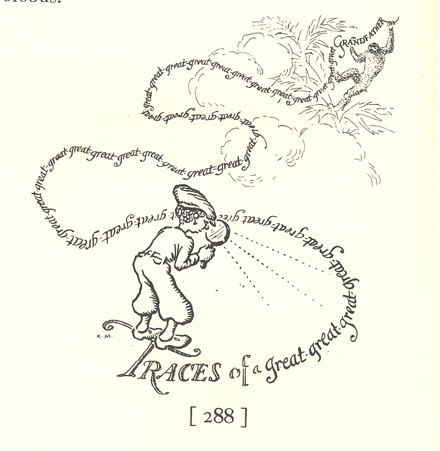
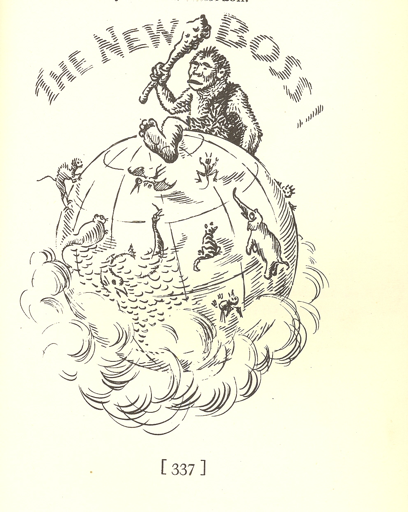
William Maxwell Reed‘s 1929 book The Earth for Sam is one of the first American children’s books to engage with evolution. ( I have found six other books from the same time period) In an example endemic of all these children’s evolution books Reed claims; “We saw life become a cell, then a group of cells. In turn there have appeared before us the fish, the amphibian, the reptile, and the mammal.” He goes on to address human decent directly; “Finally from among the mammals there appeared the primates and from among the primates the European white primates who founded the British Empire and the United States of America.” While the textbooks were becoming conservative, often not even mentioning the word evolution, children’s books emerged boldly asserting an ancient earth, and the decent of man.
I think this example may be a fruitful one for considering the relationship between children’s books and textbooks more generally. Every student gets the textbook. I think this may well make them a much more conservative medium. In contrast children’s books can be marketed to smaller niche groups of parents and librarians; allowing them to encompass a broader range of perspectives. Because Historians and Sociologists considering the place of evolution in the history of American education have focused on textbooks they have missed some nuance in this history. Instead of Scopes forcing education to become much more conservative, the trial appears to have had a polarizing effect. Simultaneously forcing the conservative medium of textbooks to cut out evolution and in parallel creating enough public interest in the topic to substantiate a new genre of children’s literature on the topic.
Pictures from William Maxwell Reed, The Earth for Sam: The Story of Mountains, Rivers, Dinosaurs and Men. New York: Harcourt, Brace and Company, 1929.




 Trevor Owens